

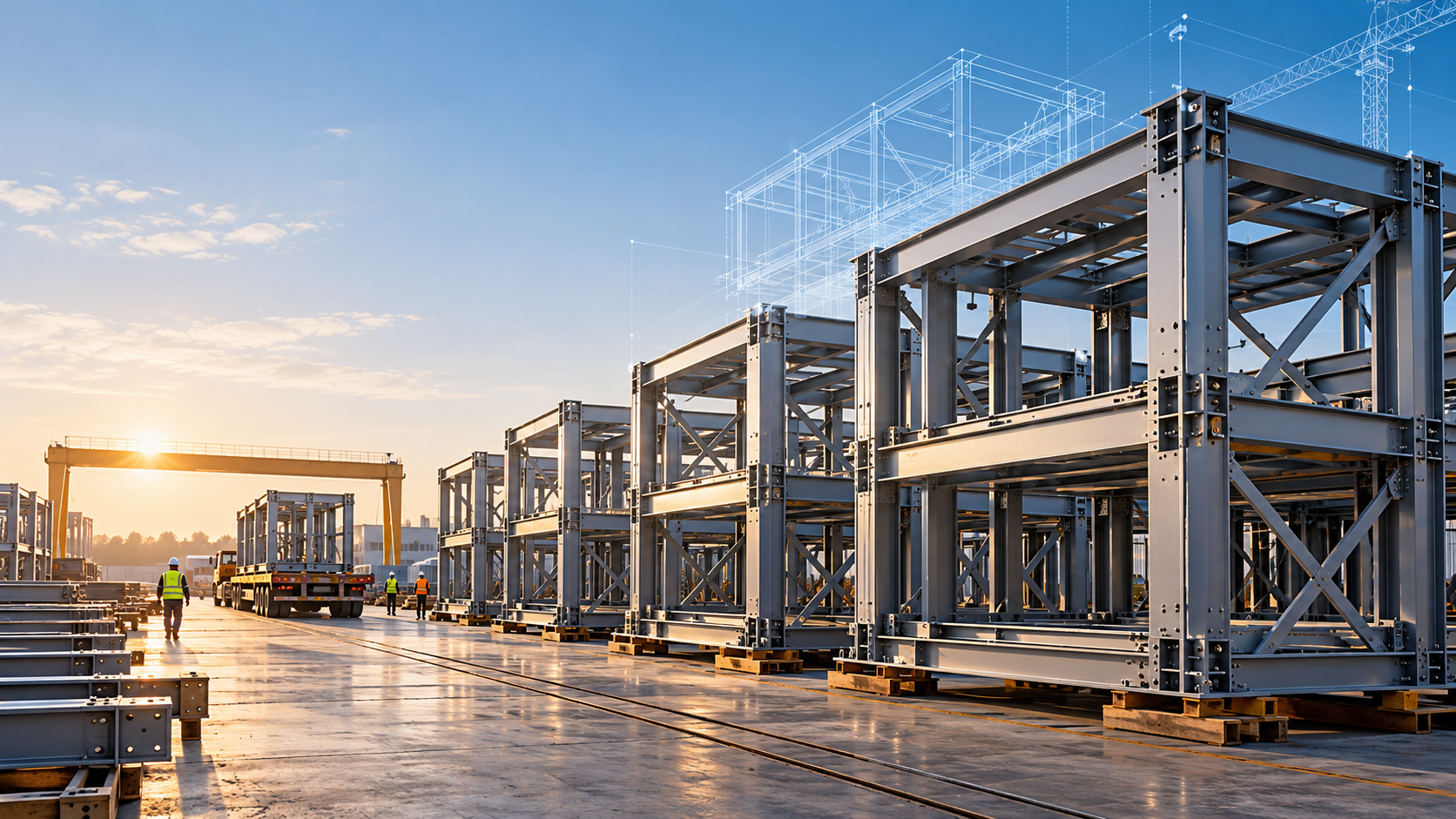
Prefabricated Steel: 5 Detailing Trends That Shorten Project Timelines
Prefabrication promises a simple advantage: produce more steel offsite so crews can assemble it faster onsite. Yet a factory-built frame is only as efficient as the information used to manufacture, ship, and install it. In 2026, the more useful question is not how much work moves into the shop, but how precisely design, fabrication, and erection are coordinated.
Consider a warehouse project using repeated roof trusses. If connection revisions arrive after several trusses are welded, the fabricator does not just revise one drawing. The same correction may affect multiple assemblies, inspection records, loading plans, and the promised erection sequence.
For fabricators and contractors, five prefabrication trends show why steel detailing precision has become a schedule-control requirement.
1. Design for Manufacture and Assembly Comes Earlier
Design for Manufacture and Assembly (DfMA) encourages teams to consider production and installation while structural decisions are still being developed. Detailers can flag difficult weld access, oversized assemblies, repeated connection variations, or unclear module boundaries before these issues reach the shop.
When connection types and assembly interfaces are agreed early, fabricators can plan fixtures, labor, and procurement with fewer late revisions.
Timeline benefit: Less redesign between engineering approval and production release.
2. Fabrication Models Carry More Production Information
A coordinated 3D model increasingly supports shop drawings, bills of material, piece marks, and compatible fabrication data rather than acting as a visual reference alone. SDS2-based workflows, for example, can connect modeled members and connections with downstream documentation.
That connection is useful only when teams validate model status, numbering, material specifications, and changes before exporting data. An accurate automated output cannot correct an unresolved design conflict.
Timeline benefit: Fewer manual handoffs and less time reconciling inconsistent shop information.
3. Repeatable Connections Replace Unnecessary Variation
Prefabrication gains efficiency when similar bays, frames, or modules use consistent connection strategies where engineering requirements allow. Standardized plate arrangements and bolting patterns can reduce shop setup changes and make inspection more predictable.
Standardization must never override design loads, geometry, tolerances, or applicable specifications. Exceptions should be visible in the model rather than hidden inside a typical detail.
Timeline benefit: Smoother batch production and fewer one-off fabrication decisions.
4. Interface and Tolerance Checks Move Upstream
Preassembled frames must meet concrete, embeds, equipment, cladding, and adjacent steel with limited opportunities for field adjustment. Small dimensional discrepancies can accumulate when multiple components are joined.
The AISC guidance on fabrication and erection tolerances underscores why teams need to understand permissible variations. Detailers should identify critical interface dimensions, survey dependencies, and adjustment provisions agreed by the responsible designers.
Timeline benefit: More predictable fit-up and fewer stops during installation.
5. Delivery Packages Follow the Erection Sequence
A perfectly fabricated module can still delay construction if it arrives before the site is ready, exceeds transport limits, or blocks the next crane pick. Model information should therefore support shipping splits, assembly marks, weights, lifting considerations, and installation orientation.
The erector and lifting specialists remain responsible for their means, methods, and engineered lifting arrangements. Detailers contribute reliable geometry and coordination information, not an unapproved lifting design.
Timeline benefit: Better alignment between shop dispatch and available site workfaces.
The Precision Checklist Before a Prefabrication Release
Before approving a fabrication package, project teams should confirm:
- Approved connection details and unresolved RFIs are clearly identified.
- Assembly dimensions, tolerances, and adjoining trade interfaces have been reviewed.
- Transport envelopes and erection access have been checked with the responsible teams.
- Model revisions match drawings, material lists, and fabrication outputs.
- Shipment groups support the planned installation sequence.
Measure drawing release reliability, first-time fit-up, fabrication rework hours, and planned-versus-actual erection progress. These indicators show whether prefabrication is delivering a real schedule advantage.
Conclusion
Prefabrication does not automatically create a shorter project. It relocates work to an earlier stage, where unresolved coordination can be multiplied across repeated assemblies.
With detailed SDS2 modeling and fabrication-ready documentation, Steel Step Solutions helps fabricators and contractors organize steel information around constructability, production, and erection needs—so precision supports the schedule from the first release.