

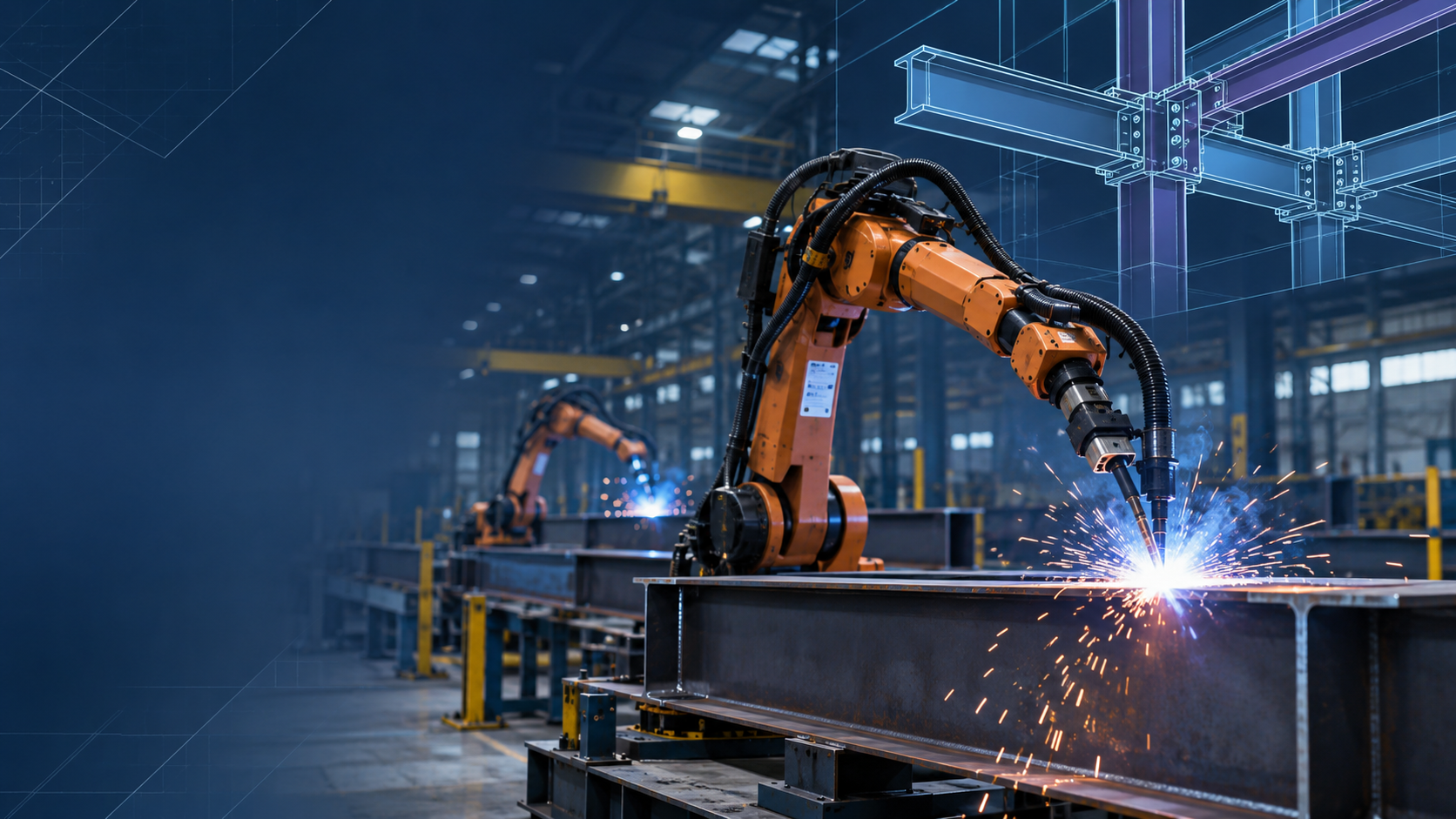
Robotics in Steel Fabrication: How Accurate Detailing Enables Automated Welding
The structural steel fabrication industry is undergoing a significant technological transformation. As fabricators face increasing pressure to improve productivity, manage skilled labor shortages, and meet demanding project schedules, robotic welding is becoming an increasingly practical solution.
Automated welding systems can perform repetitive fabrication operations with consistent movement and controlled welding parameters. However, the effectiveness of these systems depends on more than robotic equipment.
Accurate structural steel detailing and reliable 3D modeling provide the geometric foundation needed for successful robotic welding.
When fabrication models contain incorrect dimensions, poorly coordinated connections, or incomplete weld information, automated equipment may require additional programming, manual corrections, or repeated setup adjustments.
Understanding the relationship between steel detailing and robotic welding is therefore essential for fabrication companies planning to introduce automation.
The Growing Role of Robotics in Structural Steel Fabrication
Traditional structural steel fabrication involves several labor-intensive processes, including material preparation, cutting, drilling, fitting, welding, inspection, and handling.
Although CNC machinery has already automated many cutting and drilling operations, welding structural steel assemblies has historically remained difficult to automate.
Unlike high-volume manufacturing, structural steel fabrication frequently involves unique beams, columns, connection plates, stiffeners, and welded assemblies.
Each component may require a different welding sequence, torch orientation, or workpiece position.
Modern robotic welding systems are addressing these challenges through advanced software, 3D modeling integration, machine vision, and automated path planning.
Depending on the equipment and software, robotic systems can:
- Identify weld locations using digital fabrication data.
- Generate or assist in generating welding trajectories.
- Position welding torches at specified orientations.
- Perform repeatable welding operations.
- Use sensors to compensate for certain fit-up variations.
- Record production and welding process information.
These capabilities allow fabricators to consider automation for a broader range of structural steel components.
However, robotics cannot independently correct every error in the underlying fabrication information.
Why Accurate Steel Detailing Matters for Robotic Welding
A robotic welding system needs reliable information about the components being fabricated.
This includes member geometry, attachment locations, weld requirements, connection configurations, and the relationships between individual parts.
Structural steel detailing translates engineering design requirements into the drawings and digital models used for fabrication.
When this information is correctly developed, reviewed, and coordinated, it provides a dependable starting point for automated manufacturing.
1. Accurate 3D Geometry Supports Welding Path Generation
Robotic welding equipment must understand where weld joints are located in three-dimensional space.
Detailed models can provide information about:
- Beam and column dimensions.
- Plate locations and orientations.
- Stiffener and bracket geometry.
- Weld joint positions.
- Assembly relationships.
- Potential obstructions surrounding weld locations.
For example, consider a structural steel column containing multiple welded stiffener plates.
If the stiffeners are modeled at incorrect elevations or orientations, the robotic welding program may not align with the physical assembly.
Accurate detailing reduces discrepancies between the intended fabrication geometry and the information used to plan welding operations.
However, the actual components must still be correctly fitted, positioned, and verified.
2. Connection Detailing Supports Weld Accessibility
Structural steel connections must satisfy engineering and fabrication requirements.
From an automation perspective, they must also be evaluated for welding accessibility.
A connection may be structurally acceptable while still presenting significant challenges for robotic equipment.
Closely spaced plates, restricted access around stiffeners, or complex joint geometry may limit the ability of a robotic torch to reach the intended weld.
Detailed 3D models allow project teams to assess these potential restrictions before fabrication begins.
Where appropriate, detailing coordination can identify issues involving torch clearance, workpiece positioning, and fabrication sequence.
Any proposed modification affecting structural requirements must be reviewed and approved by the responsible engineer.
3. Consistent Fabrication Information Reduces Programming Effort
Robotic welding systems can use model-derived information to support offline programming and automated path generation.
This can reduce the need to manually define every welding movement.
However, successful integration depends on the specific robotic platform and the available data exchange methods.
A complete detailing model does not automatically become a robot-ready welding program.
Fabricators may need additional information concerning weld types, sizes, joint preparation, coordinate systems, welding procedures, and equipment-specific programming requirements.
Consistent model organization and disciplined revision control make this integration more reliable.
How SDS2-Based Steel Detailing Supports Automated Fabrication
Advanced structural steel detailing software such as SDS2 enables detailers to develop coordinated 3D steel models containing members, connections, and fabrication information.
These models can support downstream manufacturing workflows when paired with compatible software and fabrication equipment.
At Steel Step Solutions, SDS2-based detailing is an important part of developing accurate structural steel models and fabrication drawings.
For robotic welding applications, a coordinated digital model helps fabricators establish a reliable source of geometric information.
The typical workflow involves:
Step 1: Structural model development
The detailing team develops the steel model using approved engineering drawings, project specifications, and connection requirements.
Step 2: Connection and assembly coordination
Connection plates, stiffeners, attachments, and fabrication requirements are reviewed for dimensional consistency.
Step 3: Fabrication model verification
Members and assemblies are checked for modeling errors, interferences, and unresolved detailing issues.
Step 4: Digital data preparation
Relevant geometric and fabrication data are transferred into compatible downstream systems according to the fabrication equipment’s requirements.
Step 5: Robotic programming and validation
The fabrication team uses the available data to plan welding operations, verify access, and validate robotic movements.
Step 6: Physical fit-up and welding
Actual assemblies are positioned and checked. Robotic welding is then carried out using qualified procedures, appropriate machine calibration, and required inspection controls.
This workflow demonstrates why detailing accuracy is important throughout the automated fabrication process.
How Robotics Can Improve Fabrication Efficiency
When implemented correctly, robotic welding can provide several operational advantages.
Consistent Welding Operations
Robots can execute programmed movements with a high degree of repeatability.
This supports consistent torch positioning and process control when the assembly geometry and welding conditions remain within the qualified operating range.
However, repeatable movement alone does not guarantee weld quality.
Weld procedure qualification, material preparation, fit-up, and inspection remain essential.
Improved Production Planning
Digital models can help fabrication teams plan welding sequences and identify potential setup restrictions.
When robotic programming is integrated with production planning, fabricators can reduce avoidable interruptions associated with unclear or incomplete fabrication information.
Reduced Dependence on Manual Programming
For suitable assemblies, model-based path generation can reduce the programming effort required for each workpiece.
The actual benefit depends on assembly complexity, software capabilities, production volume, and the degree of integration between detailing and robotic systems.
Better Use of Skilled Fabrication Personnel
Robotics can perform selected repetitive welding operations while experienced welders and fabrication personnel focus on complex joints, process supervision, quality control, and tasks that remain unsuitable for automation.
Challenges That Fabricators Must Address
Despite the potential advantages, robotic welding is not appropriate for every steel assembly.
Common challenges include:
Fit-up variations: Actual root openings and component positions may differ from nominal model geometry.
Limited torch accessibility: Certain connection configurations restrict robotic movement.
Programming compatibility: Digital fabrication data may require processing before it can be used by robotic systems.
Welding procedure requirements: Automated welding must follow applicable welding codes, qualified procedures, and project specifications.
Model revisions: Changes to connection geometry or member configuration may require updates to robotic programs.
In US structural steel fabrication, relevant requirements commonly include applicable AISC provisions and AWS D1.1/D1.1M, with additional requirements where specified.
A disciplined coordination process between engineers, steel detailers, fabrication managers, and automation specialists helps address these challenges before production.
The Future of Robotic Welding Is Model-Driven
As digital fabrication technology develops, robotic welding systems are becoming more capable of interpreting complex structural assemblies.
Machine vision, laser-based seam detection, robotic simulation, and adaptive welding controls are helping equipment respond to differences between modeled and actual conditions.
Nevertheless, reliable engineering and detailing information remains essential.
Automation performs best when accurate digital models, controlled fabrication processes, and appropriate inspection procedures operate together.
For steel fabricators, investing in detailed and coordinated 3D modeling is therefore not simply an improvement to drafting operations.
It is an important step toward a more connected manufacturing workflow.
How Steel Step Solutions Supports Fabrication-Ready Steel Detailing
Steel Step Solutions Pvt. Ltd. provides structural steel detailing, SDS2-based 3D modeling, shop drawings, connection detailing, and erection drawings for structural steel projects.
Our focus is on delivering accurate, coordinated fabrication information that helps steel fabricators and project teams manage complex structural requirements.
As fabrication technology continues to evolve, dependable detailing remains fundamental to efficient manufacturing and successful project execution.
Planning a structural steel project involving advanced fabrication or robotic welding?
Connect with Steel Step Solutions to discuss your structural steel detailing requirements and develop a reliable digital foundation for fabrication.